
‘Grafana’s Big Tent’ podcast: Welcome to season 3!


Sometimes the simplest questions spark the most entertaining rabbit holes. Questions like: “Can you monitor a candle without starting a fire?” or “Should your robot boat have redundancy, or just a twin?”
Today, we’re excited to kick off season 3 of “Grafana’s Big Tent” — the award-winning podcast about the people, community, tools, and tech shaping observability — to answer these pressing questions (and more).
We launched “Grafana’s Big Tent” in 2022 to spark fun, open conversations across the observability community. The show embodies and celebrates our “big tent” philosophy — the belief that you should be able to access your data anywhere, and use the observability tools and strategies that work best for you. Most importantly, the podcast has resonated with the open source community, with more than 30,000 downloads across 120+ countries.
In the first episode of season 3, you’ll hear a live recording from GrafanaCON 2025 in Seattle, featuring hosts Mat Ryer, Principal Software Engineer at Grafana Labs, and Tom Wilkie, Grafana Labs CTO. The topic? Homelabs gone wild, adventures in tinkering, and IoT wins and fails.
Our hosts are joined by Ivana Huckova, Staff Software Engineer at Grafana Labs; Andrew McCalip, Head of Research and Development at Varda Space Industries (and builder of an autonomous drone-ship); and Brad Fitzpatrick, Chief Engineer at Tailscale, creator of LiveJournal, and former member of the Go team.
The group discuss everything from a self-righting boat to dog happiness monitoring (version 2 pending) and a “magic wand” wishlist for Grafana. Oh, and we learn why switching between pounds and kilos mid-sentence is a dangerous maritime practice.
You can watch the full episode in the YouTube video below, or listen on Spotify or Apple Podcasts.
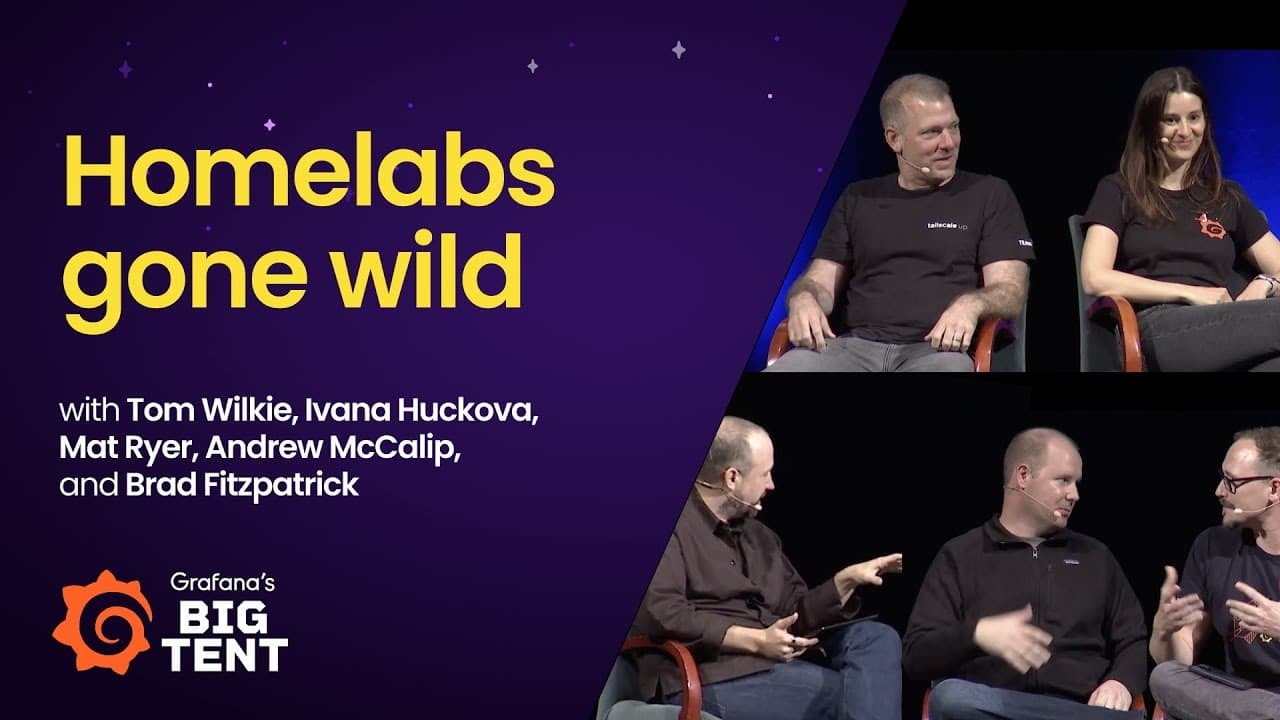
Note: The following are highlights from episode 1, season 3 of “Grafana’s Big Tent” podcast. The transcript below has been edited for length and clarity.
First tinkers: from ZX Spectrums to 5,000-lb garage surprises
Mat Ryer: My dad was into computers really early, so we had a ZX Spectrum at home. That’s where I learned BASIC first. I loved it — you could make things happen in this little universe. I’ve been hooked ever since. I kind of miss when tech used to be rubbish; now everything’s shiny and just works.
Brad Fitzpatrick: We had a bootleg Apple II my dad made from stolen parts and a stolen ROM. He taught me to program when I was like five or six, and I kind of haven’t stopped since.
Andrew McCalip: I sort of shocked my parents when I was 14 — I brought home this old CNC machine, a 5,000-pound monstrosity, and parked it in the garage. That was the start of my hardware career… and there’s basically always been a CNC around since.
Ivana Huckova: I joined Grafana as a frontend engineer, so naturally my onboarding project was a little IoT monitoring solution. My manager Dan mailed me an ESP32 board in an envelope, with all the sensors. That really sparked everything — since then I’ve built monitoring for my sourdough starter, my avocado plant, my standing desk, and I once tried to build a dog happiness monitoring solution. That one failed, so it’s on the list for version two.
Useful 3D printing: beyond trinkets
Tom Wilkie: I saw on your profile you’ve got a 3D printer. What have you actually been using it for?
Brad: My kids wanted one for Christmas, then lost interest after about a day… so now I have a 3D printer. At this point, half our house is plastic. I’ve printed baby-proofing corner guards, a Wi-Fi mount. We had this bathtub with a tiny one-inch gap at the back where everything fell and you couldn’t reach it, so I printed a shelf that clicks together and fills it. Now nothing falls down there.
Tom: You’re the first person I’ve asked who didn’t just say ‘I printed parts for more printers.’
Brad: Oh no, I love CAD. Making useful stuff is the fun part.
Tom (to Andrew): But you’ve got a real 3D printer… or rather a CNC, right?
Andrew: Yeah, a 17,000-pound Haas CNC. You can actually pay people to move something that big on 18-wheelers. I think of it as a metal compiler — metal goes in, parts come out. It’s super-satisfying.
IoT wins (and one smoky fail)
Ivana: With my plant monitoring, I learned more than from any blog post — how much water they need, how much sun, what the light looks like over the day. I was terrible at taking care of plants, but after wiring all this up I actually became good at it. One of my biggest failed projects was candle monitoring. I wanted to watch the PM particles when you blow a candle out, and I also wanted to know if I’d left a candle burning after leaving the apartment. The idea was that if it was still on, I could remotely shut it down. So I built a system where a wooden lid would drop on the candle. During testing, the lid… caught fire. I did at least learn that you shouldn’t mess with fire when you’re outside your apartment.
Tom: My laser cutter is in the garage for exactly that reason — not in my office. Also, it smells terrible.
Ivana: And as for dog happiness v1 — my dog is very hairy. Double-coated, very long hair. I tried using a heart rate monitor on him, but if you just strap a sensor onto a lot of fur, it’s not very reliable. I also put a little camera on him, and every time his heart rate went up, it took a photo. The results were mostly hair, feet, and pavement. So I need a better heart rate sensor, or a different camera placement. I’m not abandoning the idea — version 2 is definitely on the list for a future Grafana hackathon.
Tom: I have five 3D printers in my office. I dread monitoring the air in there. I am made of microplastics now.
The ocean robot: ballast, barnacles, and “redundancy”
Tom: I want to ask about your ocean-going drone ship. How are you going to handle terrible weather? What happens when it inevitably capsizes?
Andrew: Good question. If you’re not careful, things in the ocean don’t stay upright. So we gave the boat a really deep keel with a big lead ballast. If it flips over, the idea is it self-rights. We actually wrote a whole Python script to model the hydrodynamics and buoyancy, then tested it in water a few times — it works great.
Brad: Did you model the keel breaking?
Andrew: We have two models: the strong keel and the fast keel. Priority one, since we’re mechanical people more than software people, was ‘Make sure it doesn’t flip over.’ Priority two was ‘turn it off and back on again.’
Tom: Do you have a secondary backup control system?
Andrew: No. No backup. There was a big philosophical debate about redundancy. Is anything truly redundant? In the end we decided the easiest redundancy is: make a second boat. So we test, test, test, and when we’re happy, we ship it.
Tom: And when it fails in the ocean, how do you get to it to reboot it?
Andrew: We don’t. We’ll tell Twitter, ‘It was last seen at this latitude/longitude. If anybody finds it, please tow it back to Los Angeles.’ It’ll just be out there floating around.
Tom: Does it have a name? And why is it not Boaty McBoatface?
Andrew: Boaty McBoatface was a strong contender, but it’s kind of taken. It’s called Bob, after the Bobiverse books — sci-fi about a sentient spacecraft that makes copies of itself and explores the universe. It’s poetic, and also a pun.
Parting words
It wouldn’t be Big Tent without a nod to history.
Brad: LiveJournal was like Twitter in 1998. The first client was a Windows app with a single input bar across the bottom of your screen. You typed, hit Enter, and it posted. No paragraphs — hitting Enter just posted it. Somehow it ended up with millions of users. In the opening scene of that Facebook movie, the actor playing Zuckerberg is actually on LiveJournal. That’s my little movie cameo, via software.
Tom: I don’t think anything I’ve written has ever been in a movie.
Mat: What a flex.
“Grafana’s Big Tent” podcast wants to hear from you. If you have a great story to share, want to join the conversation, or have any feedback, please contact the Big Tent team at bigtent@grafana.com.