

%3Aquality(90)%2F&w=3840&q=75)
%3Aquality(90)%2F&w=3840&q=75)
Hackathons at Grafana: How week-long experiments turn into features


If you haven't already heard, we love hackathons here at Grafana Labs. And we're more than happy to talk about all the benefits that come from them—big and small.
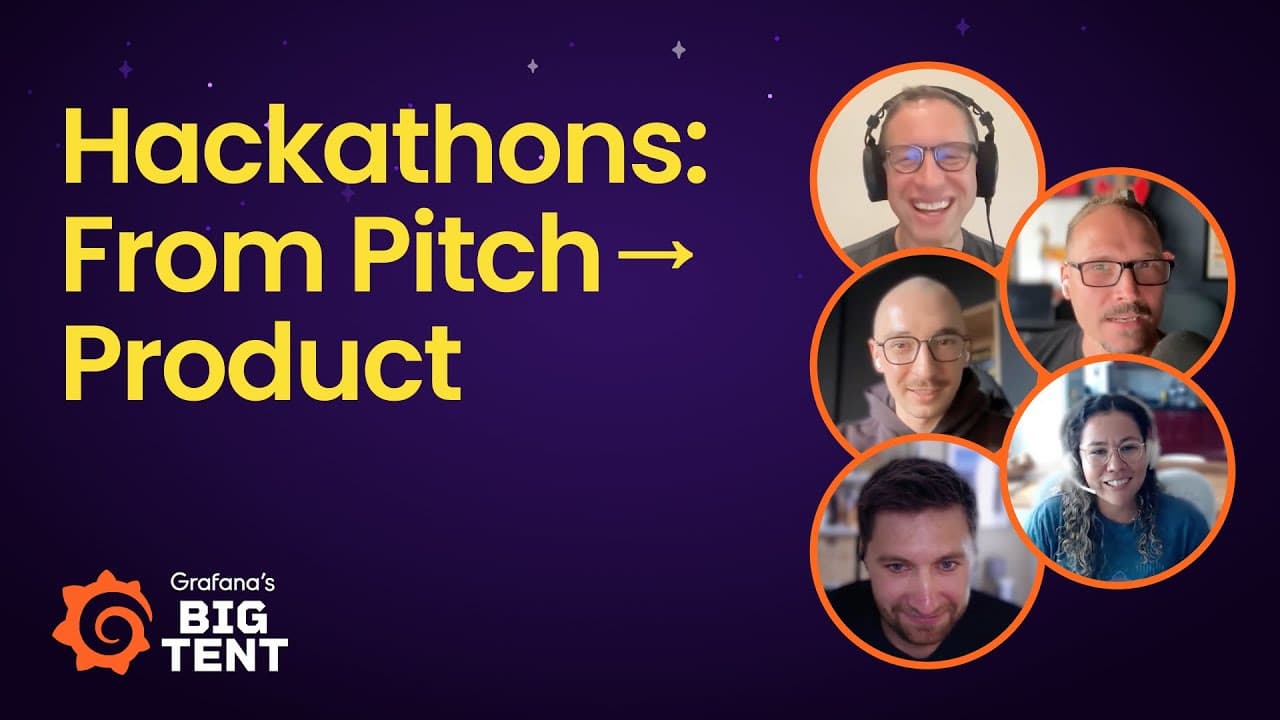
That's why, in this latest episode of "Grafana’s Big Tent," hosts Mat Ryer (Principal Software Engineer, Grafana Labs) and Matt Toback (VP, Culture, Grafana Labs) sit down with Grafana Labs Staff Software Engineers Sven Großmann, Alexa Vargas Ortega, and Lukasz Gut to talk about hackathons— the beginnings, the pitches, the tooling, and the surprising ways week-long projects can change product direction.
You can watch the full episode in the YouTube video below, or listen on Spotify or Apple Podcasts.
(Note: The following are highlights from episode 4, season 3 of “Grafana’s Big Tent” podcast. This transcript has been edited for length and clarity.)
How teams find each other and why hackathons are special
Sven Großmann: I think it's sometimes a good mix of just, like, you know, you have a draft idea of a team and I need someone who's good at front end or something like that, and then you ask your friends, your colleagues—or I mean for chess, you can just ask in the chess channel, I'm sure there's one. Because it's also a good opportunity to get to know more people.
Matt Toback: And honestly, wonder if one of the times we do it, that could be a rule. Because it is very different. It's harder in some ways, because you don't know the people. But it's a great way to also meet people that you haven't worked with before and also get a completely fresh perspective on an idea.
Lukasz Gut: I think this is one of the greatest things about hackathons here at Grafana—that you actually go outside of your bubble and have the opportunity to work with other amazing people. And the truth is, we have so many here at the company that, yeah, it's just a real pleasure, right? And normally, without the hackathon, it's not so easy to get alignment across multiple teams. You usually don't have time for much experimenting if there is no real commitment to the project. So this hackathon week gives really great flexibility, I think, to engineers just to get to know each other and also see what are the strengths of other people across the company. This is really amazing.
Pitching the idea: short, clear, and sometimes prepped ahead of time
Matt: There is this thing at the beginning where you have an idea and you have to communicate it to this smaller group of this team to be able to get it across. What's that like? Because it feels like there's a lot of building. But there's also a lot of communicating—kind of like, what you can accomplish in a week?
Mat Ryer: These projects, you've got to be able to explain them quickly. You haven't got time when you're out on the high seas. Also, the wind is cold and it's loud out there. [But seriously, if ] you have an idea, you ought to be able to succinctly explain it to someone. And thinking about what the project is, is part of that.
So if it's a great idea but you can't quite articulate it, you haven't quite thought it through or you're going to need to hack on it more to figure out what it is.
Lukasz: So for me, it definitely starts a way earlier than the hackathon. For the last hackathon, the idea actually popped into my mind a few months earlier when I was reading some materials on what an agent or an LLM agent or LLM-based agent actually is. And I remember I was reading some sort of a blog post that would explain how to build one in Go in particular. And I remember reading it and being like, It can't be this simple. It can't be a bunch of for loops marshaling and unmarshaling and calling functions.
And then it turned out it actually is that simple. I put together quickly a prototype, and indeed it was. And then I remember we had an offsite with my team in Barcelona. And I just went ahead and started pitching this idea for what later became an agentic monitoring project for the hackathon. So I remember trying to pitch the idea from a couple of different angles and see how different people react to it.
And when I actually found the angle that gets people excited, I came back from the offsite to my home office. I wrote down a very quick product in just a couple of paragraphs so there is something to share with the people. And then just before the hackathon, I started sharing this. I said, "I have this idea. If nobody wants to join, I'm going to do it anyway. If anyone can come along for the ride, please, here it is. This is what we are going to be building."
And I did it like twice or three times already, kind of this loop where I go, I start to pitch something, and then when I see some sort of saturation that people are excited about a particular angle at the problem, I try to write this down so I can have some artifact that I share with everyone. And it makes it so much easier to align on Day Zero of the hackathon.
Scope and outcomes: MVP mindset and 'good enough'
Mat: There's something about the first version, it just has to be good enough, it just has to be a little bit better than what you had without it and then it's valuable. And I think hackathon teaches us that a bit. You can deliver a small bit of value and it doesn't have to be fully fleshed out or fully realized. And that's how I like to work anyway. My first versions of things, they are kind of hackathon-quality PRs; usually scope is cut way down.
Lukasz: And I think you touched on something really important here. You mentioned two hackathon projects in which you took part personally, right? And then they actually made it to the product. I think this is a big part of what makes Grafana hackathons really successful. And also why engineers across the board are just super excited because they know that if they build something—or maybe I won't speak for anyone; it is definitely something that keeps fire within me.
If I build something cool for the hackathon, it usually doesn't even matter if you win because there are just so many projects and the bar is so high for the internal hackathon that it's not always about winning. But the fact that if a project is good enough, gets enough recognition, that you will actually get a shot and can build it into a fully fledged product or maybe into a feature.
And yeah, there are just so many examples of these projects that I see shipped. I think the Drilldown apps are probably the most remarkable one because for me personally, it's changed just the way I use Grafana overall. I very rarely go into the OG Explorer panel at this point. So that's really amazing to see.
AI tooling and faster iteration
Mat: Since Cursor and other AI kind of assistant tools, a lot of hackathons are now working software. Whereas before we used to have more slides and just like a hack together prototype, now you can actually ship working features. I saw some people just build a feature, something that they've just wanted to build for a while and haven't had the opportunity to, they just build a feature and it's a PR. And in that case, it's a kind of review and they're happy to maintain it. And then why not merge it?
It gives you that satisfaction, doesn't it? So what's the general feeling in this room: Is building it as a feature? Is that better? Does that make everything better because it's more real and it speeds along that development? Or is it constricted somehow because now the expectation is that it has to be fully functional?
Alexa Vargas Ortega: In my case, I don't take any of the code of hackathon as feature-ready. Like that slows down my way of working. If I am in hackathon mode, I will just go and explore as many ways as I can to just deliver something. And then, if this is something that is valuable, I will spend time making it feature-ready. So I frequently don't go into that direction. However, on this hackathon, I was using [...] Claude Code, the CLI one. And for me, that's the perfect companion because my editor is not VS Code, it's Vim. So with Claude Code on Vim, it was really, really good. ... So the plugin application that I created, it's missing unit tests, but it's actually generating good enough code that I could go now and see like, OK, we need to refactor things here and there, but it was working and it was nice.
Lukasz: Agentic tools, they make it so much fun and so much more competitive.
The delightful detours: birds, chess, and creativity
Mat: How would you put traces, logs, or metrics onto observing a chess game? Let's do this quickly.
Sven: Moves over time, I guess. I mean, a trace is simple, right? It's just how a piece moves, maybe. So you'd be able to go and see, like, this rook would have made all these individual moves throughout the game. And then, maybe events would be when a rook takes out another piece or something like that. Like an event at a trace.
Mat: Oh, that's kind of fun. And then what would you alert on? I guess anything, but what would be interesting?
Sven: A check, obviously.
Mat: I'm curious, is this how most hackathon projects start? Something absurd like this that then turns into a real idea?
Sven: Yeah, definitely. I think so. I mean, it sounds like a fun project to do, right? Because, I mean, the chess community is big. And why not just observe things that you normally don't observe?
Closing moments: what’s next?
Mat: Quickly, what's your next thing you're going to hack on if you've got an idea? Alexa, do you have something else next?
Alexa: In my team right now, we are working on a new project about saved queries—"query library." So I really want to do something that is aligned with that project and connected with that project. So I'm already thinking—because it's a week that I can explore, right? So maybe it's just trying different things around integrating these two things and maybe moving in that direction of: Hey, maybe this is a good idea if we want to promote that feature. That will be my thinking for now.
Mat: Matt, are you ever going to take part in a hackathon? Are you allowed to?
Matt: The Thanks Bot was a hackathon project.
Mat: Thanks Bot. What do you do with thanks bot?
Matt: You say thanks with it.
“Grafana’s Big Tent” podcast wants to hear from you. If you have a great story to share, want to join the conversation, or have any feedback, please contact the Big Tent team at bigtent@grafana.com.
%3Aquality(90)%2F&w=3840&q=75)
%3Aquality(90)%2F&w=3840&q=75)


