


Capabilities |  |  |
|---|---|---|
Search and investigate your logs quickly | Loki is optimized for the label-filtered, structured queries that SREs use most during incidents: filter by service, time range, and log level; aggregate; correlate with metrics. For these patterns it’s fast at a fraction of the storage cost. Learn more | Industry-leading full-text search. For ad-hoc, unstructured log queries, Elasticsearch is among the fastest options available. |
Troubleshoot every layer of your stack
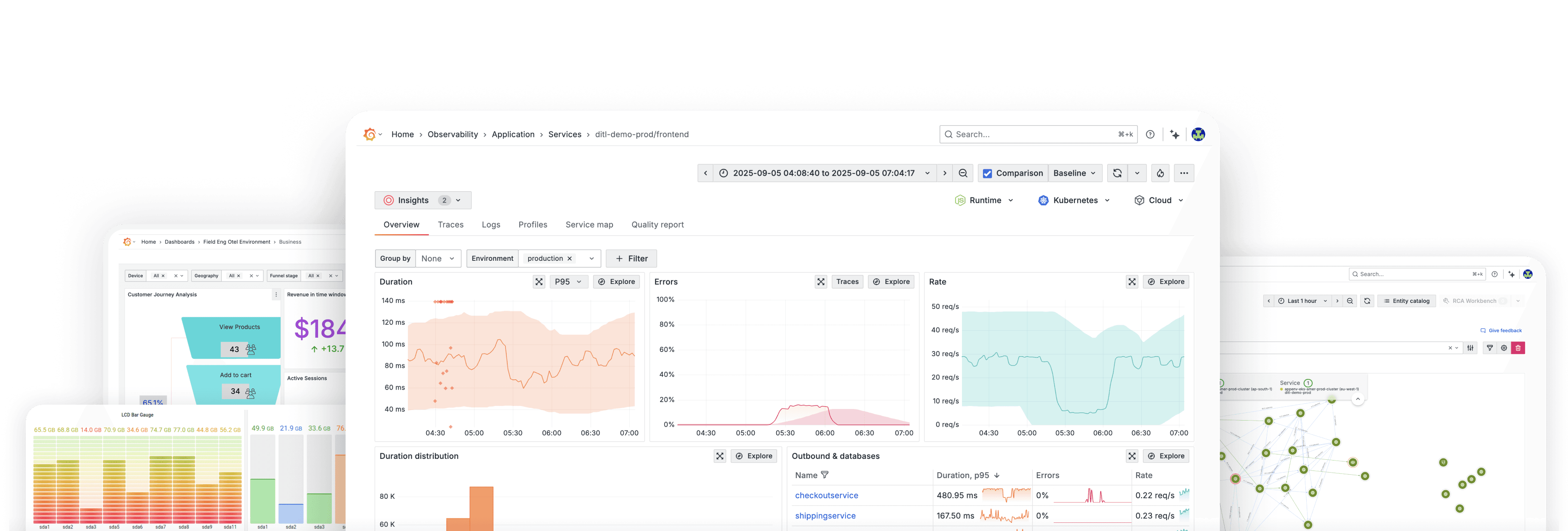
| Logs, metrics, traces, and profiles share one UI, common labels, and a unified alert model. Pivot between signals in tailored views for your frontend, backend, databases, infrastructure.
Learn more | Strong individual observability products for logs, metrics, and APM. Combining them into a coherent workflow typically requires managing Elastic APM, ELK Stack, and Kibana as distinct systems. |
Keep observability costs predictable as you grow | Loki stores logs on object storage with a label index. Adaptive Telemetry automatically reduces ingest volume across logs, metrics, and traces, so costs track your actual signal value, not raw data volume. Learn more | Full indexing at ingest means storage scales with index size (often larger than raw log data). Memory allocation drives cluster tier costs. Data Transfer & Storage fees apply in Elastic Cloud. |
Instrument once with open standards | Native OTLP ingest; no format conversion. Grafana Labs is a top-10 OTel contributor with a seat on the governing board. Grafana Alloy is 100% OTel compatible. Learn more | Accepts OpenTelemetry data, but converts it to Elastic Common Schema (ECS) at ingest. Full-fidelity APM still benefits from the Elastic Agent for complete coverage. |
Visualize and alert on data from anywhere | 150+ data source plugins let you query and correlate Elastic, Prometheus, CloudWatch, databases, and more in the same dashboard, with no data migration required. Learn more | Billing uses Compute Capacity Units (CCUs)—every query, alert evaluation, or API call consumes CCUs, making growth hard to predict. |
Investigate incidents faster with AI
| Grafana AI Assistant can investigate incidents across your Grafana-native data sources and MCP integrations. The Knowledge Graph maps service relationships from OTel and Prometheus data automatically, to help surface root cause. Learn more | Elastic ML and anomaly detection are mature and performant. Elastic Assistant is available for search and observability workflows within the Elastic platform. |

Elasticsearch vs. Grafana Cloud
Open standards, predictable bills, and unified incident response
Get the full observability picture without indexing the whole haystack
Trusted by everyone from startups to the Fortune 500








Looking for the Elastic plugin? It helps you visualize Elastic data within Grafana.
Visit plugin pageWhy teams choose Grafana Cloud over Elastic
Elastic is a powerful search platform, but when engineering teams are scaling their observability practice, many reach for Grafana Cloud: an observability-focused platform that unifies logs, metrics, traces, and profiles in one place, with economics designed for the volume of data produced by cloud-native applications.
Pay for the signals you use, not every word you index
Elasticsearch indexes everything. For observability log volumes, that model comes with a cost: storage grows well beyond your raw log size and tuning the system can consume significant engineering time. Grafana Cloud takes a different approach: store operational logs on inexpensive object storage and index only the metadata needed to route queries. Teams that switch report lower log bills and operational overhead.
“We were spending half of our time making sure everything was up and running with the ELK Stack and tuning our logs continuously.”
OpenTelemetry-first, from collection to query
Grafana Labs holds a seat on the OpenTelemetry governing board and is a top OTel contributor. Grafana Alloy is a fully OTel-native collector: your instrumentation stays in standard format all the way from collection to storage to query. This matters when you want to swap backends, add new signal types, or simply avoid being locked into a proprietary schema.
“Having made the jump to OpenTelemetry as part of working with Grafana, I lose less sleep about what could potentially come next.”
Every signal in one place: no context switching
Elastic has expanded its observability offering over the years, but many teams still find themselves managing Elastic APM, the ELK stack, and Kibana as distinct products with different configurations and data models. Grafana Cloud was built ground-up for observability: logs, metrics, traces, and profiles share a single UI, common labels, and a unified alert model. When an incident starts, you can pivot between related signals without leaving the screen.
“With [Grafana Cloud] we have one tool for anything and everything about observability. We can prepare our own dashboards from every single data source. We don’t need to switch between consoles in order to analyze a crisis or an incident.”
Start alongside Elastic—migrate at your own pace
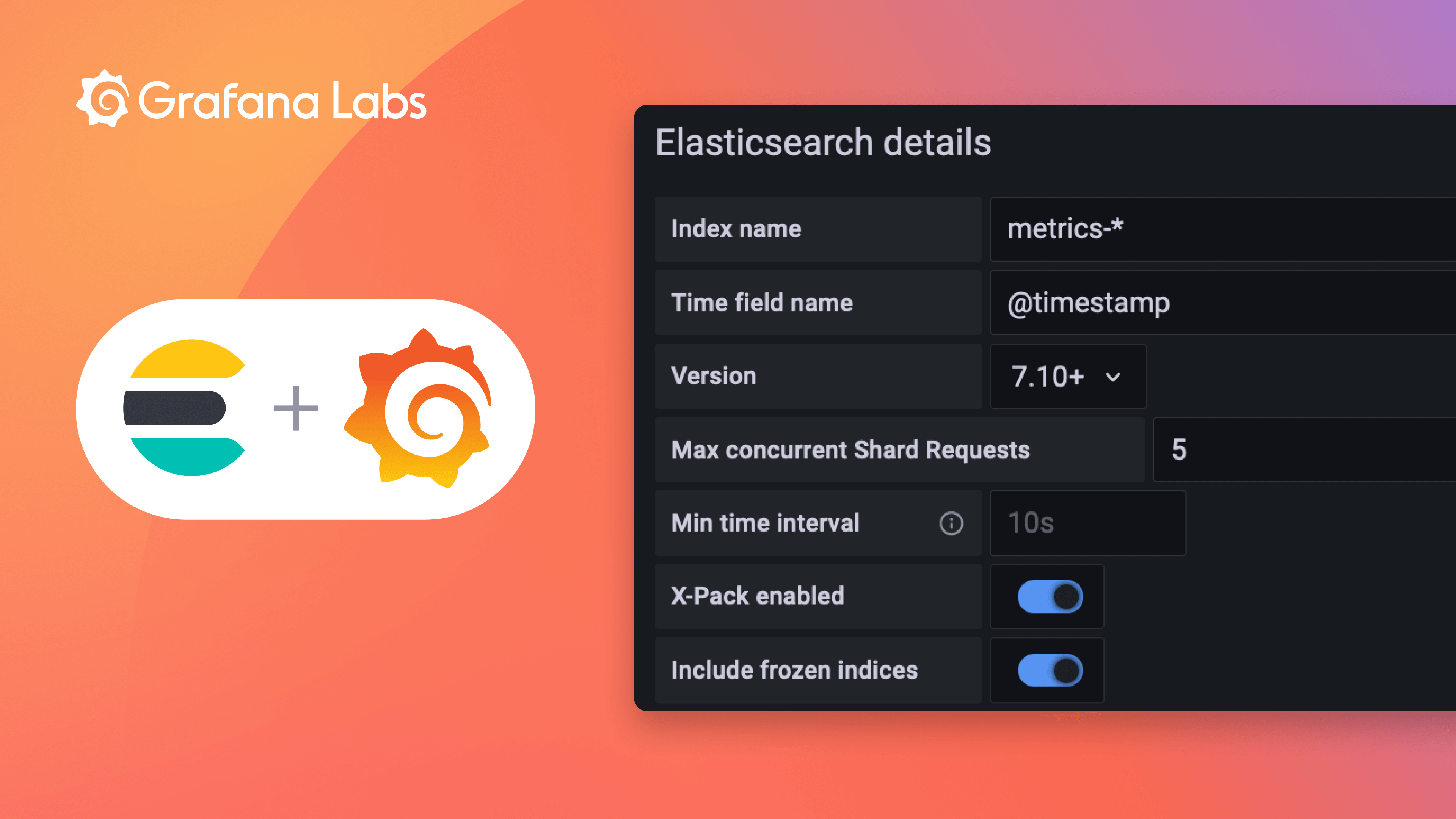
Grafana Cloud includes a native Elasticsearch data source, so your team can start building unified dashboards across Elastic and other tools on day one before migrating a single byte. Many teams run Grafana on top of Elastic for weeks or months before deciding to move log workloads over, which keeps risk low and gives teams time to build confidence.
“We’ve had migrations from Datadog. We’ve moved from Elastic. Grafana has been really the key to helping show us the way to do it.”
Grafana Labs: A Leader in the 2025 Gartner® Magic Quadrant™ for Observability Platforms
Gartner evaluated 20 vendors based on their Ability to Execute and Completeness of Vision, and Grafana Labs was positioned furthest in Completeness of Vision.

Gartner®, Magic Quadrant™ for Observability Platforms, By Gregg Siegfried, Matt Crossley, Padraig Byrne, Andre Bridges, Martin Caren, 7 July 2025
Gartner and Magic Quadrant are a trademark of Gartner, Inc., and/or its affiliates.
Gartner does not endorse any company, vendor, product or service depicted in its publications, and does not advise technology users to select only those vendors with the highest ratings or other designation. Gartner publications consist of the opinions of Gartner’s business and technology insights organization and should not be construed as statements of fact. Gartner disclaims all warranties, expressed or implied, with respect to this publication, including any warranties of merchantability or fitness for a particular purpose.
This graphic was published by Gartner, Inc. as part of a larger research document and should be evaluated in the context of the entire document. The Gartner document is available upon request from Grafana Labs.

Scope & identify
Align on a migration timeline
Set and agree on key outcomes
Identify potential blockers early
Build open communication channels

Define & design
Define observability requirements
Catalogue existing observability assets
Develop a migration blueprint
Design Grafana best practices for your organization


Ready to try Grafana?
Whether you’re trying to cut costs, simplify your stack, or just get more out of your telemetry, Grafana Cloud can help.



Welcome to
The open observability cloud
Built on open source, open standards, and open ecosystems
The Free Forever plan
Create free accountPlans to suit every scale
Explore Cloud plans