
Build, buy, or open source? Understanding your options with Grafana’s AI-powered observability


Some questions in engineering never go away. Here’s one that every team eventually confronts:
Do we roll up our sleeves and build the tooling ourselves, or do we buy something built for us?
It’s a choice that has the power to speed teams up or hold them back.
With the rise of AI-powered observability, this familiar software dilemma has re-emerged with higher stakes and faster-moving technology. Leaders need to decide:
- Should we invest time building AI capabilities ourselves?
- Or should we adopt an end-to-end AI experience that’s integrated, maintained, and evolves with our telemetry stack?
At Grafana Labs, we see organizations wrestling with these decisions every day. And there’s a misconception we often hear, that the choice is binary: build vs buy. But the Grafana community has long known there’s a third path: leveraging open source as the space between building and buying.
Know your options
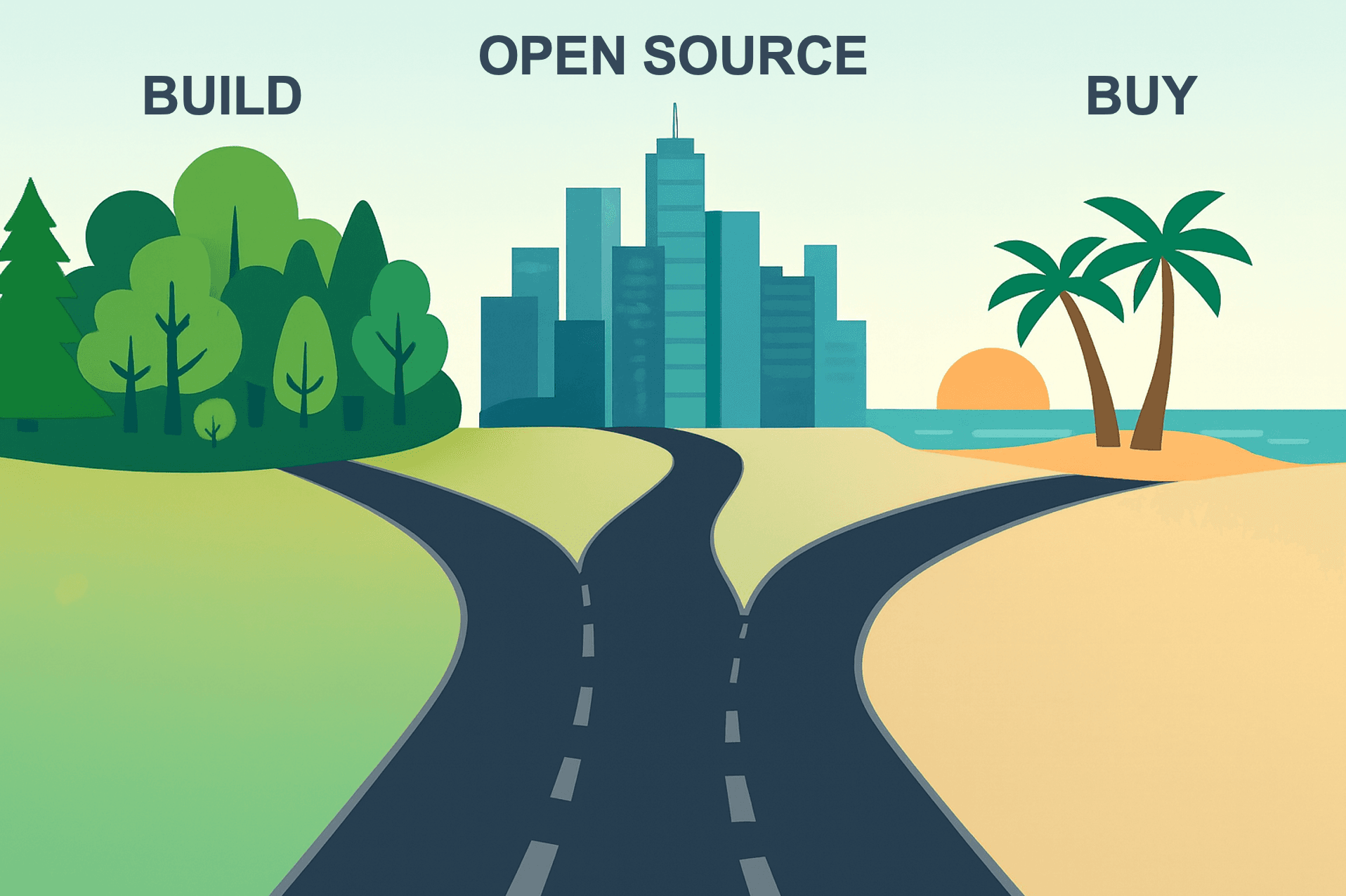
In fact, the reality is closer to a three-lane highway approaching a junction. Each lane offers a different speed, level of control, and maintenance commitment—and each leads to a different outcome.
Let’s break it down.
Lane 1. Build: Maximum control, maximum overhead
Some organizations decide to build AI-powered observability capabilities entirely in-house. That means:
- Designing LLM and agent orchestration
- Wiring natural-language prompts to query generation across telemetry signals
- Building embedding pipelines for context
- Managing model drift and prompt libraries
- Creating interfaces, RBAC, and workflows
- Supporting multi-signal correlation logic
- Maintaining, scaling, and upgrading the system over time
If offering observability experiences powered by AI is your core differentiator—for example, if you are an observability vendor yourself—then investing at this level may make sense.
But for the vast majority of teams, building means committing to months of cross-functional work before you see meaningful results—and ongoing investment long after. Industry research has repeatedly shown that building AI systems in-house involves far more than integrating a model, often slowing time to market as teams build pipelines, operate infrastructure, and ensure system reliability, all alongside ongoing core product work.
Lane 2. Open source: Flexible and powerful, but not a complete AI solution
Open source is where Grafana’s heritage shines. Teams can:
- Bring their own AI through the Grafana MCP server
- Build automation on top of OSS primitives
- Avoid lock-in and keep infrastructure transparent
This “middle lane” is the on-ramp many organizations use as they begin exploring AI-powered observability. Open source gives you a strong foundation without requiring you to start from scratch—proven tools for collecting, storing, and querying telemetry, built on open standards and shaped by a large, active community. This flexibility allows teams to experiment, extend, and adapt their observability workflows as their systems and requirements evolve.
But open source observability is a foundation, not a complete AI solution. Turning that foundation into a usable AI-powered experience requires systems that open source doesn't provide out of the box.
Teams must design and operate their own approaches to agent orchestration, prompt design and versioning, model selection and tuning, and ongoing evaluation of AI behavior. They are responsible for deciding how context is assembled, how responses are validated, how failures are handled, and how the system is refined over time as data, usage patterns, and expectations evolve. This added responsibility is the flip side of open source’s flexibility.
For some organizations, this tradeoff is not just acceptable—it’s required. Open source offers a level of control and transparency that can be difficult for managed services to match. Teams decide where their data lives, how it flows through their systems, and which components are allowed to access it. The constraints of highly regulated environments, air-gapped networks, or organizations with strict internal compliance requirements can make open source the only viable path.
For organizations without those constraints, that tension—between flexibility and ongoing ownership—is what leads many teams to consider a managed approach.
Lane 3. Buy: Out-of-the-box intelligence, tuned to your context
Ask any engineering team today and you’ll hear the same thing: The workload rarely shrinks, but the expectations always grow.
When you’re stretched thin, every hour counts. In that environment, you have to protect the time and focus of your team. The work that directly supports your core competency deserves your attention—and for everything else, it makes sense to lean on solutions that lighten the load.
That’s why many organizations look to managed solutions: not because they can’t build something themselves, but because it simply isn’t the best use of their team’s time. When your engineers can offload the things that aren’t central to your business, they get to spend more time on the work that moves the needle.
And building observability tooling—especially AI-powered observability—is our core competency.
At Grafana Labs, we’ve spent more than a decade helping teams understand, explore, and operate their systems. That experience doesn’t just shape our platform; it drives our commitment to building actually useful AI that enhances how engineers work every day. Our goal is not to add more dashboards or more noise—it’s to reduce toil, streamline workflows, and help people make better decisions faster.
That’s why we built two pillars of AI assistance in Grafana Cloud:
- Grafana Assistant is your co-pilot across the Grafana ecosystem. It helps you navigate complexity with natural-language interactions, assists with query generation and refinement, guides you through gaps in your telemetry, and makes it easier for anyone—not just beginner users or observability experts—to get answers quickly.
- Assistant Investigations works alongside you like a team of specialists. It continuously pulls together relevant signals, surfaces insights, identifies likely causes, and collaborates with you throughout an issue—proactively helping you understand what’s happening without requiring you to chase every detail yourself.
Both of these capabilities are built with deep intention: to make operating complex systems easier, faster, and far less burdensome. Behind the scenes, we’re putting a lot of work into making Grafana Assistant and Assistant Investigations genuinely useful for engineering teams. AI in observability isn’t something you build once—it’s something you refine constantly.
We’ve built multiple foundational layers that shape how these AI features learn, adapt, and stay aligned with real-world engineering needs:
- Context-aware model orchestration: We analyze which models, tools, and retrieval methods are best suited for specific tasks, from generating queries to correlating signals to assisting in root cause analysis. This orchestration helps AI make smarter decisions about how to help you, when to dig deeper, and when to surface something important.
- Continuous evaluation and improvement cycles: Every release incorporates lessons from real user interactions, edge cases, and emerging patterns in observability. We refine prompts, adjust reasoning strategies, and expand the system’s understanding of how telemetry evolves. This ongoing iteration ensures that AI stays aligned with what teams need today — not what they needed a year ago.
- Deep integration across telemetry signals: Grafana Assistant and Assistant Investigations aren’t standalone experiences; they’re woven throughout dashboards, queries, metrics, logs, traces, profiles, alerts, and more. These integrations mean that AI can operate with richer context and support workflows that span multiple components of your stack.
- Customization and extensibility through open interfaces: We provide ways for teams to shape AI to their environment, whether that’s connecting internal systems through custom MCP servers, enriching AI with domain-specific rules or metadata, creating playbooks to guide investigations, or integrating proprietary knowledge sources that guide reasoning and responses. This allows organizations to tailor Grafana’s AI to their internal context while still benefiting from the underlying models, orchestration, and observability-aware logic we maintain.
We know that today, many organizations wrestle with the question of where to use vendor-provided AI features and where to build their own agentic systems that integrate deeply with internal tools and data. We don’t see those as mutually exclusive.
Grafana’s AI features are designed to accelerate common observability workflows (alert summaries, query generation, root-cause analysis) without requiring teams to reinvent the wheel. But for organizations that want to go deeper, with internal knowledge graphs or custom LLM agents, Grafana’s open APIs, data model, and plugin ecosystem make that possible.
Our philosophy has always been to offer an open and composable solution. That means we expect customers to combine Grafana with their own AI innovation—not be locked into a single black-box solution.
The beauty of the Grafana ecosystem: you’re never stuck in one lane
Whether your team is early in your observability journey or operating at massive scale, the question isn’t simply build or buy anymore. It’s: What lane gets us to outcomes fastest without closing future doors?
The real strength of the Grafana ecosystem is this:
- You can change lanes at any time: You’re never locked into the wrong decision.
- Start open: Build where you need to. Buy for acceleration.
- All three lanes can share the same ecosystem: A connected highway where you can shift lanes without losing speed.
Whether you’re leaning on OSS, adopting Grafana Cloud, or building specialized internal systems, Grafana gives you a common foundation that prevents your observability strategy from fragmenting over time:
- Teams that start with OSS can move into Grafana Cloud without rethinking their data model.
- Teams that adopt Grafana’s AI can still plug in internal agents, rules, and knowledge via open APIs.
- Teams that build custom systems can integrate with open standards Grafana supports to avoid building yet another silo.
No matter how you approach observability and AI, the ecosystem holds together—open, composable, and built to evolve with you. And our commitment is straightforward: we will continue evolving Grafana’s AI to make it as helpful, reliable, and effective as it can be for every team that relies on us.
More on open source and AI in observability
If you want to learn more on this topic, check out these recent videos:
Grafana Cloud is the easiest way to get started with metrics, logs, traces, dashboards, and more. We have a generous forever-free tier and plans for every use case. Sign up for free now!