

%3Aquality(90)%2F&w=3840&q=75)
Baking in site reliability with observability and AI: How SpotOn uses Grafana Assistant to keep restaurants running


When you operate a restaurant, the last thing you want to do is shut your doors and turn away guests and staff because of some technology failure. And if you're the one providing that tech, it's your job to make sure that doesn't happen.
"For us, observability is about a lot more than just dashboards and alerts. Reliability is really how we make sure our customers are able to operate, because we understand our restaurants depend on us," said Jeremy White, Vice President of Engineering at SpotOn.
SpotOn offers point-of-sale systems and a suite products to help restaurants take orders, process payments, run marketing campaigns, manage employees and tips, and more. They want their customers to focus on their guests, not the underlying tooling, and that's where Grafana comes in.
"And the challenge is bigger than just the cloud," White said. "We support hardware that's in thousands of restaurants and kitchens across the country. These are places where you deal with a lot of heat, you deal with a lot of grease. The kitchens are basically Faraday cages, so WiFi is not so great. We rely on observability to help us understand and stay ahead of a lot of those problems in order to avoid interrupting their business and their day-to-day operations."
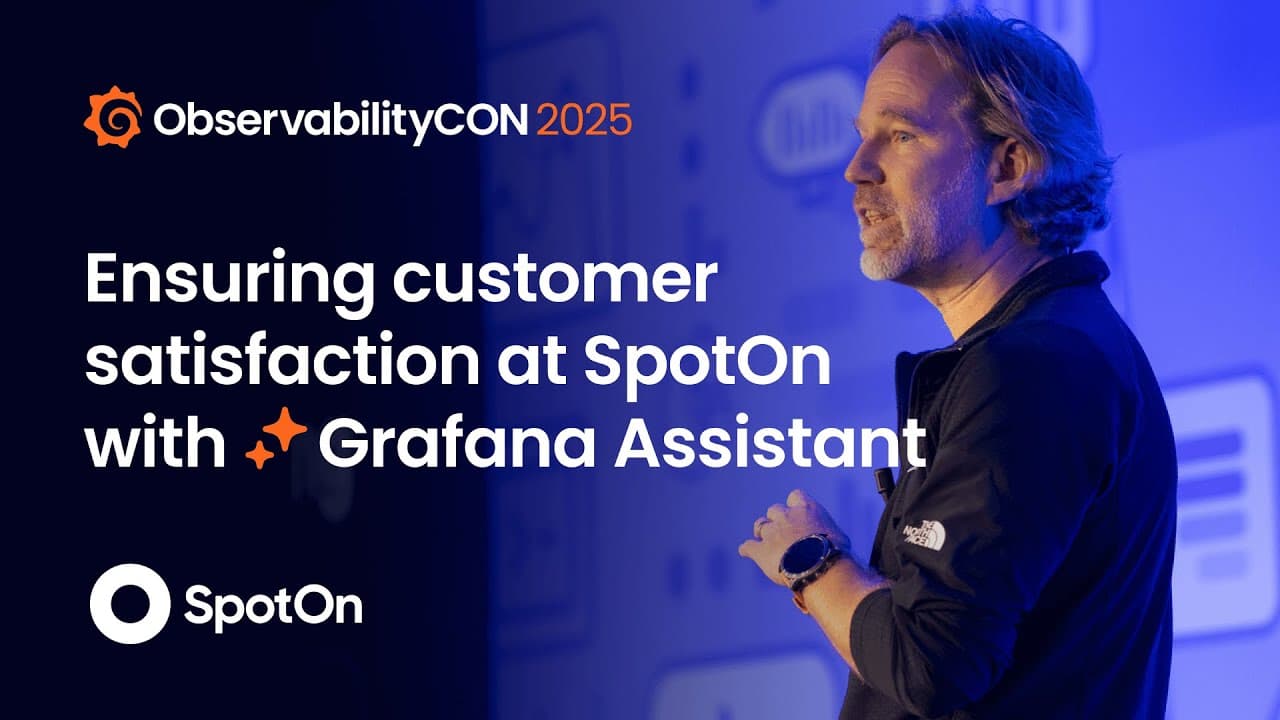
And just last week, during the ObservabilityCON 2025 keynote, White spoke about how SpotOn has started using Grafana Assistant, our context-aware AI agent built for Grafana, to help improve that reliability even further. You can check out his full segment below, or keep reading to see how SpotOn is reaping tangible benefits from Assistant, including faster onboarding, better adoption, and simpler troubleshooting.
'Observability only works when people are actually using it'
Grafana Assistant became generally available last week, but it was first released in private preview back in May. SpotOn was an early adopter, and one of the first things White noticed was how it increased internal adoption of Grafana Cloud.
"Observability only works when people are actually using it, and this is one of the areas where we found Grafana Assistant really helped us," White said. "We've gone from having new engineers stepping in and not being familiar with where our logs and metrics are for all the different services to actively being able to participate in incidents and triaging."
And it's all done through a conversation with an AI agent—no need for additional training or understanding. This has been particularly helpful when dealing with dependencies across diverse systems.
"As you span into different products and have to understand how different teams have instrumented their systems, Assistant is able to bridge that gap a lot easier for people not familiar with those teams," White said.
No more blank page problems
White has also enjoyed seeing how Assistant is solving the "blank sheet of paper problem" where new users struggle to know where to start in Grafana.
"With Grafana Assistant, we found that some people could go straight from idea to dashboard and then iterate. And that iteration was a lot easier for people to handle as opposed to solving that blank sheet of paper problem," White said. "So this has been a huge boost to our participation in observability as well as the speed to value and how quickly we can get to value for our customers."
White cited the example of a team of network support specialists whose job is to ensure the client networks are operating properly, with zero negative impact on the business.
"Now these are not Grafana experts, not even familiar with the tooling, but they were able to use Grafana Assistant to get started and create dashboards—dashboards that could look at one restaurant and be able to tell all the network devices, all the possible problems we might be seeing, pull it together in one place and allow them to triage those issues a lot faster," he said.
And the team didn't stop there, despite their lack of familiarity with Grafana Cloud. They used Assistant to help identify groups of customers experiencing issues so they could proactively contact SpotOn's support team to solve the problem—all before the customer ever calls to ask for help.
"This is a great example of where our team can focus on being subject matter experts and focus on solving customer problems, not on the tooling," White said.
Blocking out the noise
Sometimes SpotOn's observability stack generates so many signals that developers get overwhelmed. White used the example of a CrashLoopBackOff alert, which is common and could have a hundred different causes. His team used Assistant to decorate the alert and add context for why the alert fired, which is particularly helpful for engineers who aren't used to troubleshooting that specific issue.
"We had one case where it even found a null pointer reference during the transformation process in one of our services," White said. "[Assistant] noticed right when it happened during the release, and so it made it a lot easier and a lot less time-consuming for us to troubleshoot that issue and ultimately get to a solution."
Even when the assistant doesn't pinpoint the exact solution, it still helps the team build confidence about what they should be looking at—and what to rule out—so they can resolve issues faster.
"We're really excited with the capabilities of Grafana Assistant," White said. "Ultimately, it's allowed us to really focus on solving customer problems and getting to customer outcomes rather than the underlying tooling. So if anyone else is interested in accelerating their observability adoption, I'd encourage you to take a look at Grafana Assistant."
For more information on Grafana Cloud AI, including FAQs about Assistant and our other AI capabilities, check out our AI observability page.
Grafana Cloud is the easiest way to get started with metrics, logs, traces, dashboards, and more. We have a generous forever-free tier and plans for every use case. Sign up for free now!
%3Aquality(90)%2F&w=3840&q=75)
%3Aquality(90)%2F&w=3840&q=75)


