The real cost of AI adoption at scale: What we've learned about security, spend, and sanity
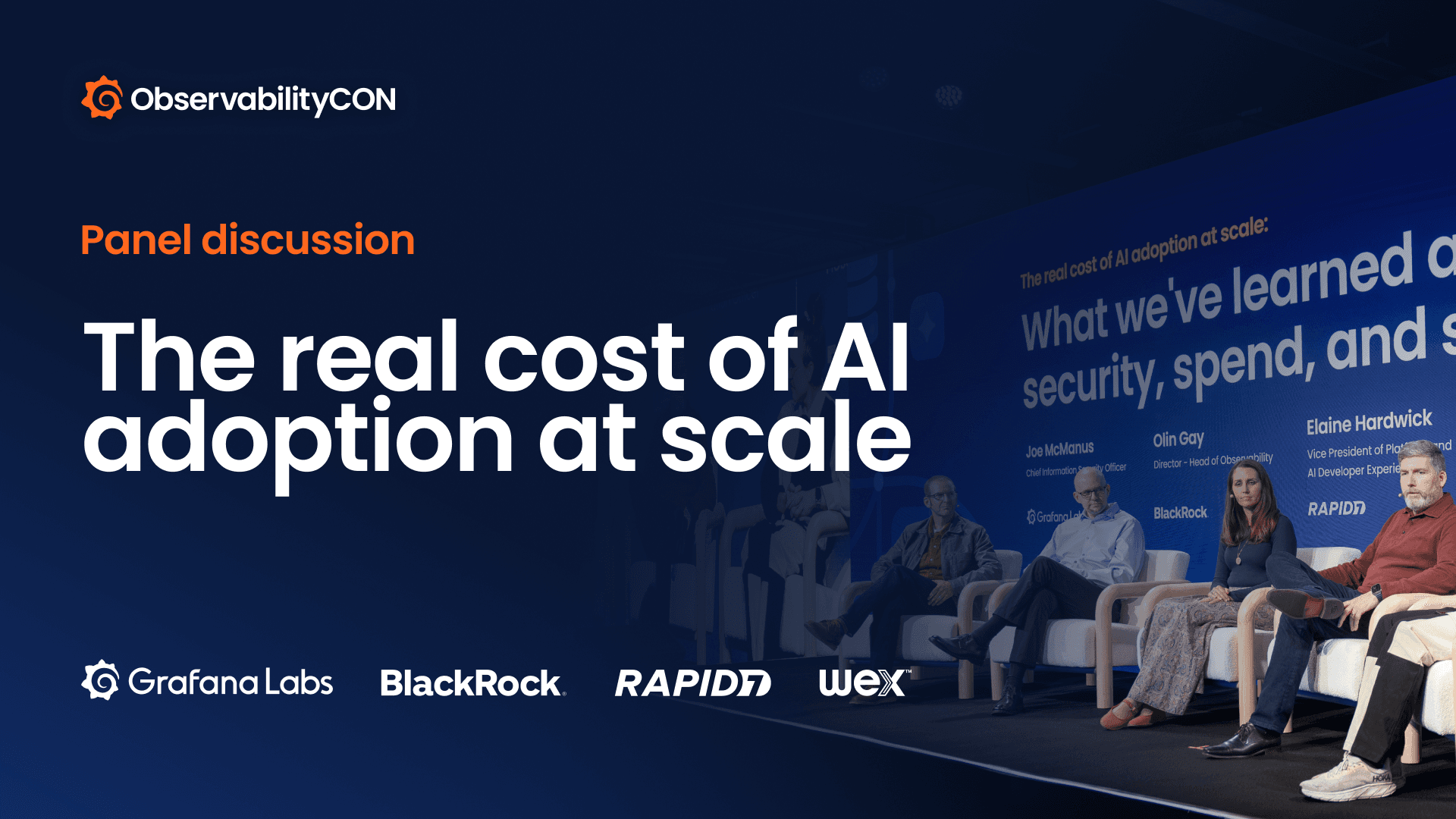
In some ways, the invoice is the easy part. When it comes to AI adoption at scale, there are plenty of other considerations for measuring the level of effort on the one hand and the return on investment on the other.
In this panel, leaders share stories about how their organizations are managing this seismic shift from four different vantage points inside the enterprise. WEX SVP and Chief Information Officer Barry Driscoll owns the budget that funds it. BlackRock Head of Service Platform and Observability Olin Gay is responsible for running it. Rapid7 Vice President of Platform and AI Developer Experience Elaine Hardwick is accountable for helping engineers adopt it. And Grafana Labs CISO Joe McManus decides where the guardrails are.
Join us for a lively discussion of the realities of AI adoption — both the highs of breakthroughs and the troughs of despair, the cultural changes and the security conundrums — and what they think is worth doing next.
Speakers

Joe McManus
Chief Information Security Officer, Grafana Labs

Olin Gay
Director - Head of Observability, BlackRock

Elaine Hardwick
Vice President of Platform and AI Developer Experience, Rapid7

Barry Driscoll
SVP, Chief Information Officer, WEX

Andrew Zigler
GTM Engineer, LinearB and host of the Dev Interrupted podcast
Anthony Woods: Now we're going to move into a panel. So there's obviously great capabilities that are coming about with the use of AI and thisogentic technologies, but there's also a lot of practical questions that are being raised, things around security, around cost and spend, and just generally around keeping our sanity. So to dive into these things, we've got some people who are dealing with these kind of problems every day. So I'd like to invite up to the stage, we've got Joe, Elaine, Barry, and Olin, and moderating will have Andrew. So come on board.
Andrew Zigler: All right. Hello. How y'all doing today? I'll try that again. It's after lunch. It's all right. How are y'all doing today? Great. Amazing. I am so excited to be here hosting this panel for y'all today. We have some amazing experts on stage with me, so I'm not going to take a lot of time to set us up here. But my name is Andrew Zigler and I'm the host of Dev Interrupted. We're a podcast and newsletter for Agentic Engineering Leaders. And today we're having a conversation that I've been having all year, and that's about the real cost of AI. We're going to get down to the bottom of it from different perspectives because cost is more than just a dollar sign, but it is a dollar sign too. We're going to be getting that scoop as well. And today there's on stage joining me some incredible guests.
I'm going to give them each about a minute to intro themselves. And so Barry, how about we start with you?
Barry Driscoll, Wex: Sure. Good afternoon, everyone. I'm Barry Driscoll. I'm the CIO at WEX based in Portland, Maine. For those that don't know WEX, we're a two and a half billion dollar FinTech in the B2B payments industry. We process over a few hundred billion dollars in payments a year in three primary segments. The first is our mobility segment, which you can think of as fleet cards. Most of that spending is on fuel. Second is benefits payments. And for those that have an HSA or an FSA, there's a good chance that WEX is the technology behind the payments for that. And then third is our B2B payments, which we're mostly focused in the online travel agency space, making payments on behalf of all those companies you use to book your trips. My role at WEX is a CIO, and what that means for us is all of our infrastructure technology, which majority is cloud-based, our employee technology services, our business systems, our platform engineering organization, and our site reliability team, which is responsible for our seven by 24 support.
And that's where observability sits for us at WEX.
Andrew Zigler: Lovely.
Barry Driscoll, Wex: So thanks for having me.
Andrew Zigler: Amazing. Elaine?
Elaine Hardwick, Rapid7: Sure. I'm Elaine Hardwick. I'm a VP of our platform and our developer experience AI, which is mouthful to say. I work at Rapid7. So for those that you don't know Rapid7, it's a cybersecurity company. We focus on preemptive MDR. So we are ingesting tons of different data sources at a very large scale, trying to enrich with all of our threat intel, all of our cloud, all of our on-premise, and making sure we're responding to things faster than those attackers. And as y'all have probably seen in the news, there's more and more of this data coming through. And so it's really important for us to get ahead of that. With my role, again, I'm platform, so I'm helping to ensure that all of our foundations are really secure and scalable and working and operating at the scale that we need. And then on the developer AI side of the house, we've kind of realized we need to go faster.
And so we have to invest in this AI SDLC initiative. And so it's adopting, measuring, making sure that we're staying ahead of these attackers with our product delivery.
Andrew Zigler: Amazing. Olin?
Olin Gay, BlackRock: Awesome. Hey everybody. Good to be back at OpsCon. So I'm Olin. I work at BlackRock and specifically I support our pass or SaaS business Aladdin, and I support two core platforms for that business. One is our service platform, so think the CMDB, the instant change management features and other service management features. And then the second, maybe more relevant here, is the observability platform. And really, I think from a scale and scope perspective, I think of our first job as another platform engineer is stability first. The platform needs to be available and working for our clients, but I think it's two important sets of clients. The first is the 5,500 engineers, data scientists, data engineers, folks that are working on financial models, et cetera. Aladdin is where they build and develop, and then all of the business users that use the platform and operate on the platform every day, that's the second level.
And so thinking about scale both for engineering and then scale for business users and most importantly, stability in my space.
Andrew Zigler: Amazing. Joe?
Joe McManus, Grafana Labs: I'm Joe McManus. I'm the CISO at Grafana. I think you might have heard of it. And so I'm in charge of the platform team, the foundations group and security that makes all the products we've been talking about. And particularly, we've moved into making these AI observability products. If you look at some of the demo, I think once before this where we were showing the conversations being recorded, making sure that we've shifted left in our development practices and we're building things that you'll trust us with your data, that we can make sure that we're reliant, we're resilient, and we can not only meet the demands of a Black Friday, but we can also ensure that if there is an incident, because there always will be an incident, that the blast radius is contained and your data is secure and there's no interruption to your services.
Andrew Zigler: Amazing. Well, as y'all can tell, we have an amazing panel assembled here today. There's some really high level expertise here at some of the largest companies that are working with data and AI. So the stakes are incredibly high. And I want us to start with, we are talking about cost today, the dollar cost, and I'm going to start there with Barry. And I want to understand from you, Barry, so in your role, how do you evaluate the AI ROI of your investments and the tooling that you've been working on with this year?
Barry Driscoll, Wex: Yeah, sure. I mean, the obvious one that people talk about is workforce productivity, and that's something that we definitely look at. And we are continuing to scale up our company and grow our company, and we're trying to do that in a nonlinear fashion relative to labor and the people that it takes to scale. So productivity is a real thing, but beyond that, we look at a lot of other metrics. We are a software company, so those platforms I mentioned are our software platforms that we sell to our customers. And one of our biggest investment areas is around the Agentic development life cycle. And what we're doing there is to increase our product velocity. So we want to be able to release products more quickly, make sure that they're high quality, make sure they're secure and all the other things. And we're seeing some really good results there.
But outside of that, we're also looking at ROI for revenue generating projects. So we are actively investing in projects to use agents to help our sales processes and can talk about examples, but that revenue generation is one of our ROI areas. We're also very keen to improve our net promoter score, and so ultimately our customer experience. So where we can implement AI to help us deliver better services to our customers, let them self-service as much as possible and have them hopefully walk away with a better experience. And then another area very apropos for this conference is around reliability. So we are investing in AI projects for reliability, incident reduction, MTTR, MTT star improvements, and we're seeing really good results there. So it's definitely not all just about labor savings, which obviously gets the most of the news.
Andrew Zigler: Absolutely. And I think that becomes a place to start. I'm curious, any of our other panelists, does any of that resonate with you or something that maybe you've seen stand out in your own company as well?
Olin Gay, BlackRock: Well, I mean, every OpsCon needs MTTR in every session. I
Andrew Zigler: Agree.
Olin Gay, BlackRock: Check that box for sure.
Andrew Zigler: We just hit our quota.
Olin Gay, BlackRock: I think the other thing though that we've been seeing is that in the observability space, the speed at which we can actually improve the maturity and the instrumentation of the application stack itself is also really important. I think that the tools can help teams that used to struggle to get the time to invest to improve the quality of their stack. Now we're seeing the AI helping to accelerate that. When you can trade tokens for better telemetry in the stack, it can be a multiplier in that way. So definitely core MTTR, but then also how to improve the maturity as well.
Andrew Zigler: Yeah. So starting with the dollar amount and then moving into how it actually gets operationalized, you talked a lot, Barry, about using it to measure cost savings and that becomes a way of proving ROI and then it moves further downstream into the organization, into the ops world. And Olin, I love that you spoke up because I want to lead with you on this next one about when you think about the operational costs of AI that maybe doesn't make it into a lot of business conversations, maybe the conversations that Barry's in, right? So how do you think about it as an ops leader and about making sure that those things get elevated and we have those real conversations about operational costs?
Olin Gay, BlackRock: Sure. I think, and I'm sure everybody else is going to have thought on this one. My general feeling is that AI has a big second order effect impact. So AI, I think we've talked about several times today already, some of the folks I met yesterday, everybody is seeing a multiplier in terms of PR and code change in their spaces. I think that's pretty much universally felt. So that's like a first order effect, but there's several second order effects that... Sorry, can you guys hear again? There we go. There's several second order effects that also matter. I think one of them is as you accelerate the amount of code change, you build more products, you build more capabilities, telemetry becomes more prevalent, products become more prevalent, and the ability for operations to support that explosion and growth is something that we're tracking against. When we get those outcomes that we want for the business, we have to support the outcomes in the ops world.
I think the second other effect that matters is agents themselves and AI itself is able to search and query telemetry much faster and much broader. When you are capped by the number of people on call who can look at a dashboard, you search less. So I think both of those factors mean that the second order effects of AI in operations especially are things we're still adjusting and figuring out.
Joe McManus, Grafana Labs: I think there are some huge hidden costs with AI. And so we've really, as you see, we're big AI users here at Grafana, but we've empowered people to code for themselves. Everybody's a citizen developer, but it's as if we've given everybody a hammer and told them that they're now carpenters. So they don't understand the fundamentals of computer science. They haven't read the Phoenix project. And so there's this downstream effect where now we're standing up, okay, do we go with Vercel? How can people deploy this securely? Do they know how to monitor it? Do they have anybody standing up to support it when it breaks? How do you support the whole SDLC? So there's a hidden cost that we have to engage with security. When do we scan it? What tools can apply? Now we had to ramp up our DLP because it's not that AI is less secure, it's that it's exposed some of the failings.
If you think the fundamentals of the CIA triad, confidentiality, integrity and availability, it's exposed some fundamentals there that maybe you didn't fix correctly when you had human actors, but now that we have non-human actors, it's really kind of highlighted some shortcomings that have had a multiplicative effect of cost for us.
Andrew Zigler: Absolutely. I think the multiplicative effect of those costs becomes a lot more real when you move into the operational world and then there's a lot of opportunities to leverage it to not only make your own feedback loops better, but those of your agents and the whole system you work in. And it also invites to reimagine and revisit the processes from before and be able to find new savings or new ways of doing stuff that are just completely re-imagined. And those become the new opportunities, I think for teams as they move through that space. And from there, I really want to move on to talk about, we've kind of covered a little bit about the dollar costs and then the ops cost. Someone has to work with it, someone has to implement with it. But in reality, there's also a cognitive cost that builds up over time and it isn't something that is immediately visible and it takes a different shape for the types of teams and ways that they're using it.
I'll give you a really firm example. AI acceleration and adoption this year has not been equally graceful to everybody in the engineering world, and we know this. If you're a front end developer, you're probably having a lot more luck a lot sooner working with LLMs to generate React than an embedded systems developer word in their own language. And those barriers kind of create an unequal kind of velocity between teams that show up as pain points and frictions. And so I want to focus a bit on that element of adoption and culture within organizations. And I want to give this one to Elaine about how you think about as an ops leader, creating the right environment for your engineers to be successful with each other and their agents without clobbering each other.
Elaine Hardwick, Rapid7: Yeah, it makes sense. It's kind of an interesting thing. I read Molly Graham's article recently about the Lego piece, and one of the things that's fun with that one is basically as you're building, you build something, you tear it down, you shift it and you give it to someone else. With AI, you don't have that ability. So one of the things that a lot of my engineers are struggling with is they're constantly building all these things, but they don't really have anyone to hand it fully over. You give part of it to AI, but you still have the accountability that you have to maintain and control and govern and make sure it's in a good spot. And so with our groups, the things that we've really focused on was first managers. As humans, we have managers and we want to make sure that they understand the workload that we're having and all the burdens that we're having.
And so we created a lot of programming around management training, making sure they understand how to go end to end through our AI SDLC, making sure that they've actually pushed PRs and had that experience and understand some of the pain points. At the same time, we have AI champions. Those are those people that are really hungry for AI and love it and want to evangelize it and want to make it a passion project for their team and share as much knowledge as possible. And so we've made a ton of investments around that, lots of training, lots of time where we can just sit and listen. I think that's probably one of the biggest things is learning from each other and figuring that out. And then obviously we have our vaults and a lot of our tools in order to make sure that we're establishing processes and patterns and things so that people don't have to relearn everything on their own.
Andrew Zigler: I'm so glad you brought that up too, because that's what I think of as it becomes a hidden cost, absolutely, where you get these different agentic centers or agentically enabled groups of folks and they all invent an agentic way of working with maybe your whole stack and they did it three times over and that's a three times over investment that you didn't need to make. And so if you had created the environment for them to surface and collaborate together, then you'd have one more cohesive system. And those become the challenges I think as we move into more operationalizing with AI and our AI SDLC from end to end is revisiting that stuff and making sure we have those kinds of conversations. And since it's unequal and different people move at different speeds, I think it's great that we have conversations as well, like the one we're having today.
And in the movement of all of that, I think it's something that can maybe be a stickler in the AI adoption journey at any organization could be security and the security team, right? It's like there's no bigger nightmare for the super agentically 1000 X engineer to get the DM from the CISO or someone in the security organization about what are you doing? Because those costs are just as real and they manifest in much uglier and even more invisible ways that are further removed from the agentic loops that are causing the problem. So I want to move into talking about guardrails and security and maybe hand this over to Joe here to think from your perspective, as a CISO, what are the trade-offs in an agentic world that keep you up at night and how do you make do with them?
Joe McManus, Grafana Labs: Well, I feel seen. We initially, when AI started blowing up, I mean it just changed. It got real so fast. We focused on what are the developers doing? How are the developers going to change with this? And honestly, the developers have not been a problem. The developers have been fantastic. At Grafana, we partnered early and we partnered often. So almost every new AI product that was shown this morning, we partner early, we shifted left, we made reusable code that we checked multiple times for security. We made sure that the sandboxes were secure. That's great. We have a fantastic relationship. In fact, we were just asked like, "Hey, can we get somebody to be fully embedded with the AI team?" I don't have to head count, but I would love to. But what keeps me up is actually the newly empowered citizen developers, because once again, AI has not made me less secure.
It's exposed failings in our platform where you would go into a tool and say, "Can you get me this information?" And we'll try every way it can to get you that information. And so what we've had to do is make sure that we have the right identities tied to the right people, that they're short-lived, they can access the right data. Some of the things we've had to do is increase our use of DLP, data loss prevention software, so we can ensure that if you follow along, we had an incident back in May.
We were part of supply chain incident, many people were hit by it. Honestly, our biggest impact from that was some of the data that people had put into GitHub from using AI tools or writing their own tools, which then falls into what you talked about earlier, multiple people inventing the same product. So at Grafana, we've really tried to say, "Here's our catalog of products." One of the founders of Grafanda helped make a staff apps product that can let people deploy their software securely. The orbit app that many of you were using, that was written with a lot of AI assistance and deployed quickly. And we had to adjust to say, "Hey, how do we do this the right way?" It changed our whole paradigm for how we deployed software.
Andrew Zigler: So when you're in that environment and you're moving so quickly as well, how do you think about creating the right kind of guardrails for people to develop safely?
Joe McManus, Grafana Labs: Well, so what we've had to do is say we put in static analysis tools into GitHub. We require PRs. We are using truffle hog. We are using everything we can to look for, are there secrets in here? Are we checking for SQL injection, cross-site scripting? So we've had these tools and we've had the plan to deploy them at these times, but accelerated all that. Now we're doing it much faster. We're building our own harnesses for doing penetration testing and vulnerability analysis for our home written software. So it's just been constantly deploying because every week there's a new thing. I mean, two weeks ago, had anybody heard of Jiv, but for one week nonstop, that's all we talked about. The world was going to change because of that. So it's really reacting quicker and sort of throwing out your roadmap because even though you're holding to the fundamentals, you're reacting much quicker and no longer you're planning a year out, you're planning weeks out.
Barry Driscoll, Wex: Yeah. So just following up on that a little bit, it's definitely beyond the developers for sure and the AI tool sprawl. And so we are facing that for sure. We're a public company. We're very highly regulated. We've got PCI and SOCs and HIPAA and HITRUST and on and on and on. And so we take security very seriously and certainly all the automation around the secure software and secure release management, all of that. But beyond that, there's a new tool every week. And so one of the friction points for WEX is the general audience idea of like, "Hey, all these great tools, let's start using them and the risk to the company of doing that." And so one of the things, we certainly have a governance process, but one of the key things is vendor risk management. We see that as one of the highest enterprise risks in the company.
And so we do a very rigorous review of those things before we allow any production data or any production usage. And so one of the things, then people feel like, "Okay, well, you're slowing us down." And so one of the things we're doing in parallel with that is trying to be really clear on the communication. It's like, "Well, this is what we're trying to protect the company from. Here's examples. This is why we use that process." And we also have our architecture review board that we're using to try to make sure we're looking at things carefully. So we do want to move fast. We've introduced a lot of tools, but it's never fast enough, but we feel like we're trying to balance pragmatic implementation with security.
Andrew Zigler: Also too, there's a balance in what you all both said. You started with a list of technical solutions to solve all of the problems, and you started by talking about it in a communication way because we have to attack it from both of those sides. And ultimately too, it's about creating the enablement because just as quickly as we can turn code into any kind of product that we're trying to deliver, writing code now is no longer the obstacle or the bottleneck. It's obviously moved into other places. And so being able to quickly take that capability and turn it inward on your own company, let's get enabled across the board, let's have that ecosystem, let's have that catalog and just take the time upfront to invest in the roots. Those become, I think, the fundamental ways of controlling and understanding and communicating about cost. And that's some of the things that have stood out to me just while we've been here.
And I'm curious to know maybe if any of our panelists have more color to add just from the worlds that they come in, are there other costs that you think we haven't talked about today that are definitely lurking and part of everyone's day to day?
Joe McManus, Grafana Labs: I would say it's really the way data moves around now has changed, right? It's before you had it in MySQL database, you had it in your G drive, but now these tools will pull everything together and aggregate it. And the end user just wants to see a quick summary of it, but not realizing it's stored somewhere. So some of the costs are now, we've had to accelerate how we're doing EDR. I wouldn't want to do this, but I could see something like WEX highly regulated where maybe now you have to have an allow list of software that could actually be installed. And we're not there, but I see why people do it because it's really this sprawl of tools, the sprawl of data is something entirely new and that's created a new challenge.
Olin Gay, BlackRock: Yeah. I think one other thing we didn't touch on is the core of the team structures that we've built have all been designed around the way that we used to build software. So it's not just the security constructs, but the actual orgs themselves. Would we design the orgs the same way now if we were launching at this moment? Do we have very large platform organizations with teams running a lot of microservices or microservices actually part of the problem because now you can more vertically integrate. Some of those things I think are costs that we're going to see because we're going to want to adapt to the way we build.
Elaine Hardwick, Rapid7: And the planning process, right? We've talked about that a lot, but our customers are expecting us to deliver X feature at this point in time on this roadmap and things are changing so quickly that you can't really commit a year out like you've mentioned. So that planning process is really kind of tilted on its head right now, I think.
Barry Driscoll, Wex: Yeah. A couple of maybe not as obvious costs to AI or the ripple effect of the AI industry that I see. One is for your software suppliers. So I don't know those that are looking at all kinds of contract renewals. The request for increased pricing is, I've never seen anything like it. And now some of this I'm sure is real, but there's also the tendency of the software vendors now to say, "Well, yeah, your prices are going to have to go up because we're spending all this money on AI." And it's like, "Well, if you're not getting an ROI on that investment, then that's your problem. That's not my problem." So we are seeing that and there's spending a lot more time on negotiation and contract renewals. And then the second one is for those that need to buy thousands of laptops for their companies, the price of laptops have increased 50 to 70% in the last 12 months as a result of the RAM shortage and just chip shortage in general, which was not something I certainly was thinking about a year ago.
So there's other ripple effects way beyond token costs.
Andrew Zigler: Yeah. Cost is very complex, y'all, as we've very much learned here today. And I think what we've learned about costs too is that there are the obvious costs, like the dollar costs, there's the hidden costs, there's the cost that you have to really root out, but there's also to the responsibility to reimagine the way we work and to rebuild the systems in a way that let us have that trust again and to let us have the most synergistic system. And so something that's really happened the last year is we've had to throw away a lot of our assumptions about how we work. It's like we talk about cost and how cost changes. I mean, think about just how building has changed in general. Everyone's obsessed with consumption pricing right now. The fundamentals are completely changing. And so because of that, there's so much opportunity to learn and build something new.
And I'm curious, just any closing thoughts about what would be your advice, the builders, leaders in the room about folks about how they can take advantage of the opportunities in the industry right now and get ahead?
Elaine Hardwick, Rapid7: I mean, mine's basic. Everything's changing. So take all of your previous assumptions, throw them out and be willing to learn and be curious and ask all those questions. I think that's the only way we're going to survive is thinking six months down the line and continuing to kind of push ourselves to see where this industry is going. Being stagnant is not an option anymore, basically.
Olin Gay, BlackRock: Yeah. And shorter iterations too on top of that, right? If you can't look that far out anyway because of that unknown and change, you might as well iterate very quickly.
Joe McManus, Grafana Labs: I'd push the partnership again. It's multiple teams working on things before it'd be one team solving it. So making sure you can get in early and sort of get that economies by all solving the same problems and not rebuilding things. And also sometimes asking yourself, should I buy it? I don't have to build it.
Elaine Hardwick, Rapid7: Yeah.
Barry Driscoll, Wex: Yeah. I guess the other thing I'd add is taking a lead from Joe's comment around system development. I'd say it's really easy to create a prototype or a demo or an individual productivity tool, but scaling that to an enterprise that needs to run seven by 24 at millions of operations securely with customers impacted directly if something breaks. So a lot is changing, but there's still some things that aren't changing. And so the processes around this stuff, so whether it's IT service management or our general controls or legal compliance, all the other things, if you want to be able to implement something and run it at scale reliably, you still got to do the basics and that's way harder than that demo. So that's the easy part.
Andrew Zigler: We've had some incredible experts up here today. Can you please put your hands together for them? This has been a super fun conversation to host. We're going to be walking off stage. If you have any follow-up questions, come find us, come chat with us. We had an amazing time up here. At least I did. I can't speak for everybody, but I had a ball. And so thanks y'all for hosting us here today or for coming here today and we'll see you soon.


