
Menu
This is documentation for the next version of Grafana k6 documentation. For the latest stable release, go to the latest version.

Open source
putObject
S3Client.putObject uploads an object to a bucket.
Parameters
PutObjectParams
Returns
Example
import {
  AWSConfig,
  S3Client,
} from 'https://jslib.k6.io/aws/0.14.0/s3.js';

const awsConfig = new AWSConfig({
  region: __ENV.AWS_REGION,
  accessKeyId: __ENV.AWS_ACCESS_KEY_ID,
  secretAccessKey: __ENV.AWS_SECRET_ACCESS_KEY,
});

const s3 = new S3Client(awsConfig);
const testBucketName = 'test-jslib-aws';
const testFileKey = 'bonjour.txt';
const testFile = open('./bonjour.txt', 'r');

export default async function () {
  // Let's upload our test file to the bucket
  const uploadResult = await s3.putObject(testBucketName, testFileKey, testFile, {
    contentType: 'text/plain',
    contentLength: testFile.length,
  });

  // Access the upload metadata
  console.log('Upload successful! ETag:', uploadResult.eTag);

  if (uploadResult.size) {
    console.log('Object size:', uploadResult.size);
  }

  // Check if checksums are available
  if (uploadResult.sha256) {
    console.log('SHA256 checksum:', uploadResult.sha256);
  }

  // And let's redownload it to verify it's correct
  const obj = await s3.getObject(testBucketName, testFileKey);
  console.log(JSON.stringify(obj));
}
A k6 script that will upload an object to a S3 bucket
Was this page helpful?
Related resources from Grafana Labs

Video
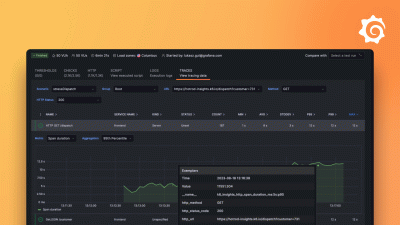
Performance testing and observability in Grafana Cloud
Optimize user experiences with Grafana Cloud. Learn real-time insights, performance testing with k6, and continuous validation with Synthetic Monitoring.
Video

User-centered observability: load testing, real user monitoring, and synthetics
Learn how to use load testing, synthetic monitoring, and real user monitoring (RUM) to understand end users' experience of your apps. Watch on demand.