Menu

Open source
HTTP instrumentation for Pyroscope
Note
The source code for this library can be found in the grafana/jslib.k6.io GitHub repository.
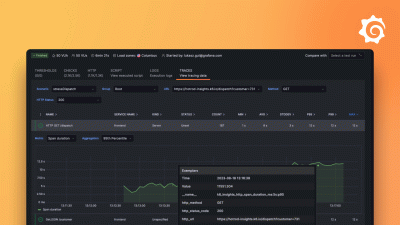
The http-instrumentation-pyroscope module allows you to instrument HTTP requests in a way that lets you tag Grafana Cloud Profiles with relevant information generated from k6 tests.
About baggage header
The baggage header is a standardized HTTP header used to propagate distributed context. The W3C specification goes into more detail on the specifics, but like many other headers, the baggage header is a list of key-value pairs.
This module, by default, adds three key-value pairs:
- Scenario name
- Name of the request (URL if not set)
- Value of
__ENV.K6_CLOUDRUN_TEST_RUN_ID, which is set automatically in Grafana Cloud k6.
API
Example
This example demonstrates how to use the this library to instrument every HTTP request made in a script with the baggage header.
import { check } from 'k6';
import pyroscope from 'https://jslib.k6.io/http-instrumentation-pyroscope/1.0.2/index.js';
import http from 'k6/http';

// instrumentHTTP will ensure that all requests made by the http module
// from this point forward will have a baggage context attached.
pyroscope.instrumentHTTP();

export default () => {
  // the instrumentHTTP call in the init context replaced
  // the http module with a version that will automatically
  // attach a baggage header to every request.
  const res = http.get('http://httpbin.org/get', {
    headers: {
      'X-Example-Header': 'instrumented/get',
    },
  });
};