





























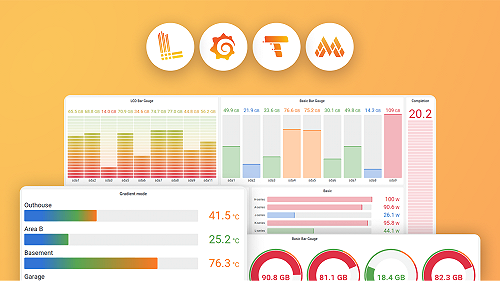
What integrations provide
| Component | Description |
|---|---|
| Pre-built dashboards | Professional visualizations, ready immediately |
| Alert rules | Sensible thresholds for common problems |
| Collection config | Configuration to gather metrics and logs |
| Best practices | Built from real-world operational experience |
Questions answered
| With integrations, you can answer… |
|---|
| Is my NGINX server healthy? What’s the request rate? |
| How many connections does my MySQL database have? |
| Is my Redis cache running low on memory? |
| Which of my Linux hosts is running out of disk space? |
Problems solved
| Problem | How integrations help |
|---|---|
| Building dashboards from scratch takes time | Production-ready dashboards included |
| Don’t know what metrics to collect | Expert-curated metric and log collection |
| Unsure what alerts to set | Pre-configured alert rules |
| Want monitoring in minutes, not days | 5-10 minute time to value |
| Can’t install agents on cloud services | Agentless integrations for AWS, Azure, GCP |
| OSS exporters generate too much data | Curated metrics reduce volume and noise |
| High cardinality driving up costs | Collect only what matters, nothing more |
Coverage
Many integrations covering: Linux, Windows, NGINX, Apache, MySQL, PostgreSQL, Redis, Kafka, RabbitMQ, Docker, and more.
Browse the full list of integrations
Fast time to value. If you’re monitoring something common, integrations are the fastest path to visibility.
Script
Now that you understand what Level 1 solves, let’s talk about how to get data into Grafana Cloud. There are three main approaches, and we’ll start with the fastest one: integrations.
Integrations are pre-built monitoring packages. Someone has already done the hard work of figuring out which metrics to collect from NGINX, MySQL, Redis, or whatever system you’re monitoring.
They’ve built the dashboards. They’ve set up sensible alert thresholds. All you have to do is install and configure.
Most integrations use Grafana Alloy to collect both metrics and logs from your systems. But some integrations are agentless. They connect directly to cloud services like AWS CloudWatch without installing anything on your hosts.
Here’s something worth knowing about cost: integrations use curated metrics. That means they collect only the signals that matter, not every metric an OSS exporter exposes. You get less noise and lower data volumes, which translates directly to lower cost.
This means you can answer questions like “Is my NGINX server healthy?” or “How many database connections do I have?” within minutes, not days.
There are many integrations available, covering everything from Linux servers to Kafka clusters. If you’re monitoring something common, there’s probably an integration for it.
And if speed matters, this is where you start.